|
| Tohmajärvi, in Finnish Karelia |
Summer Vacations in Karelia, 1919-1921
Here I have to mention our summer vacations
before the year 1921 when Father remarried and our home situation completely
changed. At school they began giving out train tickets for summer vacations to those students who had relatives in the countryside -- and we were among those who did --
Father had relatives in Tohmajärvi and Värtsilä.
Tohmajärvi 1919
In Tohmajärvi, 5 kilometers north of the village
of Kemie, lived Father's sister, Iida Kolehmainen. The name of the house was
Kolehmala. The old man of the house (her husband) was named Jussi, and his
bachelor brother was named Eemeli. During the summer of 1919, Father's brother,
Juho, who was ailing and very sickly, was looking after the house. He had
contracted a terminal illness while a prisoner of war. I can't recall him ever
saying much of anything. In my memory is etched the face of a suffering
old man and his stern, almost cold eyes. The old man, Jussi, was equally a man of
few words -- I'm sure they didn't care much for us being there -- we must have
been more of as a nuisance. But Aunt Iida was like a substitute mother to us --
gentle and understanding.
 |
| Finnish "savusauna" or smoke sauna |
We
especially enjoyed the smoke sauna and were always ready to help in getting it
warmed up. During haying time we had the sauna heated up every day. Perhaps we
were of some help out there in the fields --I remember standing on top of the
hay wagon stomping down the hay so it took up less room. And I probably was
able to swing a rake when need arose. That first summer (1919), we probably
didn’t do much more than that, just played most of the time. Every
day, however, we had to go berry-picking. Each of us had a little basket which
had to be full when we returned home. The berries were then dried in the warmth of the
baking oven, and we could later take them home as treat. The baking oven was
huge and one could sleep on the shelf above to it, and perhaps someone did. We
boys slept on a bench next to the wall, and the older folk in two bedrooms.

Uncle
Eemili was still a bachelor that first summer (1919). One day we were with him
out on the bogs where he was clearing more land for pasture. I guess he swung
his pick a bit too vigorously because he got a bad cut on his left foot. That
probably was the end of clearing the land because the old man of the house was
too infirm to do it. He was a quiet man, crippled with arthritis, very old and bent
over. We continued adventuring in the nearby forests, feeling quite at home as
we roamed around. As we had been ordered to come back with our baskets
filled with berries, and only a few could be found in any one place, this
meant going far afield to pick them.
Summer of 1920
By the following summer, that is
1920, we were quite familiar with the area. There wasn't much for us to do, so
we were constantly into mischief. Aunt and Uncle tried to find work for us to
do to keep us busy, so they sent us to a nearby farm to work for a family named Ruuth. For
some reason I recall that this house had once been in our family, but there is
no way of knowing. There we were put to work weeding the garden. For the first
two or three days we performed our required task pretty diligently. It was a
fairly easy task -- weeding the turnips and rutabagas and such which were easy
to spot among the weeds. Then we were asked to weed the carrots and by this
time we were getting tired of this kind of work.
We boys had acquired no type of work ethic or sense of
duty, because at home in Helsinki we had always done pretty much what we
wanted. We were rarely assigned any tasks, unless it was gathering firewood and
chopping it up. Somebody had to do it, if there was any firewood to be found.
If none could be found, then we had to buy firewood from the wood shop, if
there was any money. Well, our work at the neighbors became worthless. We just goofed
off together. There were a couple of boys our age at the house and we occasionally
played with them.
The Ruuth family lived most of the time in
Joensuu, but spent the summers at their farm in Tohmajärvi. There may
even have been several families living at the home, because they had cattle and
a breed bull, so some of them must have lived there even in winter. Well, this
bull captured our interest. Because it had a nose ring with a chain attached to
it, we boys decided to harass it and started throwing pieces of turf at it to
get it riled up. Some neighbor saw what we were doing and reported it to the
family. The result was that we received a few coins for our work and our
walking papers. And off we boys went!
 |
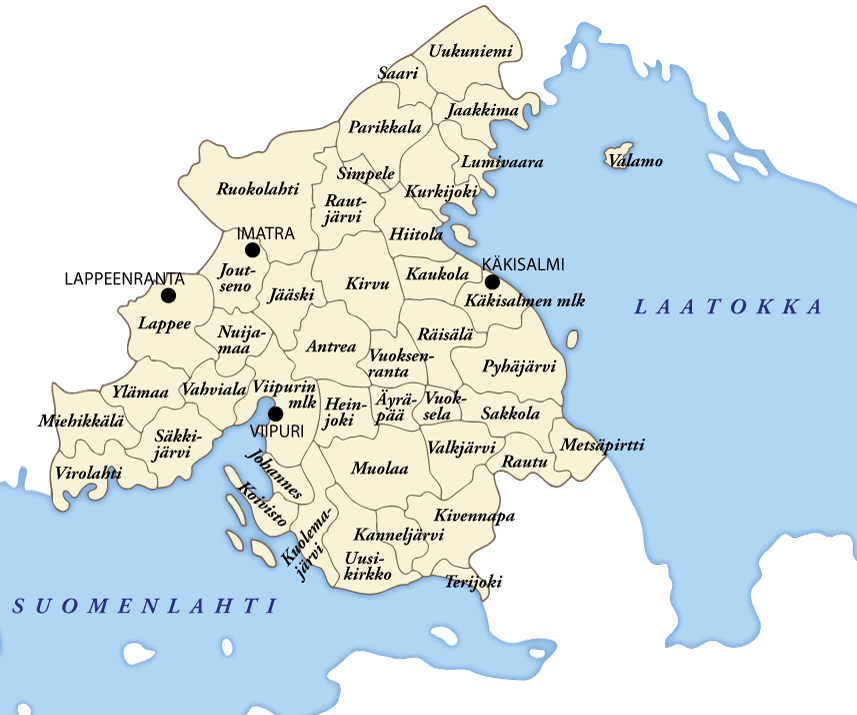
| Map of Tohmajärvi and Värtsilä area, Finnish Karelia |
Värtsilä
The
last part of the summer we were sent to Värtsilä (a few kilometrs east of to stay with our Aunt
Josefiina (Nousiainen) and Aunt Vilhelmiina (Laasonen). Actually we didn't stay
at the Laasonens. Aunt Josefiina was also a very kind and religious woman --
though she may have been a little more formal and strict than was Aunt Iida. At
least we were quite shy around her, and we had to apologize right at the start
for the silly songs we had sung to her while in the forest a year earlier. Aunt
Vilhelmiina was more gentle and quiet, but not many memories of her have
remained. I recall Aunt Josefiina much more vividly since we spent a lot more
time with her. Most likely we only spent a couple of weeks with our aunts
before we had to return home to Helsinki as school was starting again. Summer
vacation was then -- as it still is now -- three months long, June through
August. So it may have been that same summer that we took that trip to go berry
picking with Father in Haagalund.
 |
| Viborg Train Station in the 1920s |
Journey Home to Helsinki
On our way home on the train we traveled
through Viipuri, and were in awe as we gazed around inside the imposing depot
lobby. The building was truly magnificent and we wondered how we could take a
quick look around the premises. And as luck with have it, there was a kindly
young man sitting on the same bench who said he would be happy to watch our
things for us. And off we went. How long we were gone -- probably not very long
-- on our return we saw this guy carefully going through our basket. Whether he
found anything, I don't know. Maybe there were hidden gifts in there for the
folks at home we knew nothing about it. Well, we were too young and
inexperienced to pay any attention to such things. This guy may have forgotten
it, but I clearly recall this incident even to this day. Wonder if his conscience ever
troubled him?
Tohmajärvi and Karelian Food
During
our vacations in Tohmajärvi, we became very used to delicious Karelian foods,
such as oven-baked pies, talkkuna (made from a mixture of roasted barley,
rye, oats and pea flours), and Karelian pasties. Karelian talkkuna was like
a stiff pudding; you took some from a dish placed in the middle of the table
using a spoon or your fingers, which you then rolled between your palms into a
ball and popped into your mouth with a little butter. Milk was plentiful, as
was buttermilk and sour cream. We could get a squirt of warm milk right from
the cow, but I never cared for this and to this day still prefer my milk to be
cold. Having grown up in the city I wasn't used to warm millk.
Final Summer in Tohmajärvi 1921
Our last summer spent in Tohmajärvi was in 1921. Most likely we were as much of a nuisance
then as we had
 |
| Tohmajärvi and Värtsilä area in Finnish Karelia |
been on previous visits, always doing mischief and goofing
around. On one occasion then it so happened that at the dinner table we got the
giggles for no apparent reason. All we had to do is glance at one another and
we would burst into laughter. The old man finally had had enough and tapped
Veikko on the head with the bowl of his pipe. Veikko was extremely offended by this. No one
seemed to notice that in the afternoon he had gathered all his gear and walked
the 5 kilometers to the Tohmajärvi train station. Not until that night did
anyone notice that the boy was nowhere to be found. They eventually discovered
that he had walked all the way to the train station, climbed on the train and
gone home. And Father probably wrote the folks to inform them that the boy had
come home.
Lahdenpohja
I
don’t recall what Voitto’s fate was, but I spent the rest of the summer with
Uncle Eemeli Nousianen in Lahdenpohja (just a few kilometers east of Värtsilä). He owned a lemonade factory, and I helped
there washing bottles and doing other chores as well. He had a lemonade stand
by the railroad station and there I sat on many a day. There wasn’t that much business
at the stand
 |
Lahdenpohja, Viborg and Lake Ladoga. Area of
Finnish Karelia ceded to the Russians in 1944 |
so it left me free to read and ponder, whatever thoughts I might
have pondered in those days. Nothing at least comes to mind, forgotten like so
many other things by now.
I do remember that Uncle Eemeli had a hunting dog that needed to be walked
every day. One day I decided to let the dog run, and it was such a strong dog
that a little boy like me couldn’t control it. It soon got loose after having
dragged me along on my knees until they were bloody. I suppose eventually
someone found it and brought it back. On another occasion Uncle Eemeli took us
on a boat trip to some islands at Ladoga Lake. We beached the boat at one island,
but were very careful as we walked around because it was rumored that the island
had snakes. That’s where it got the name Kyysaari (Serpent Island). We did have
a picnic there, so that at least was a break from the daily routine.
Translated from the original Finnish: Marja-Leena Tolvanen-Rogers