 |
| Valto Antero Tolvanen. Military Pass. 1928-1930. |
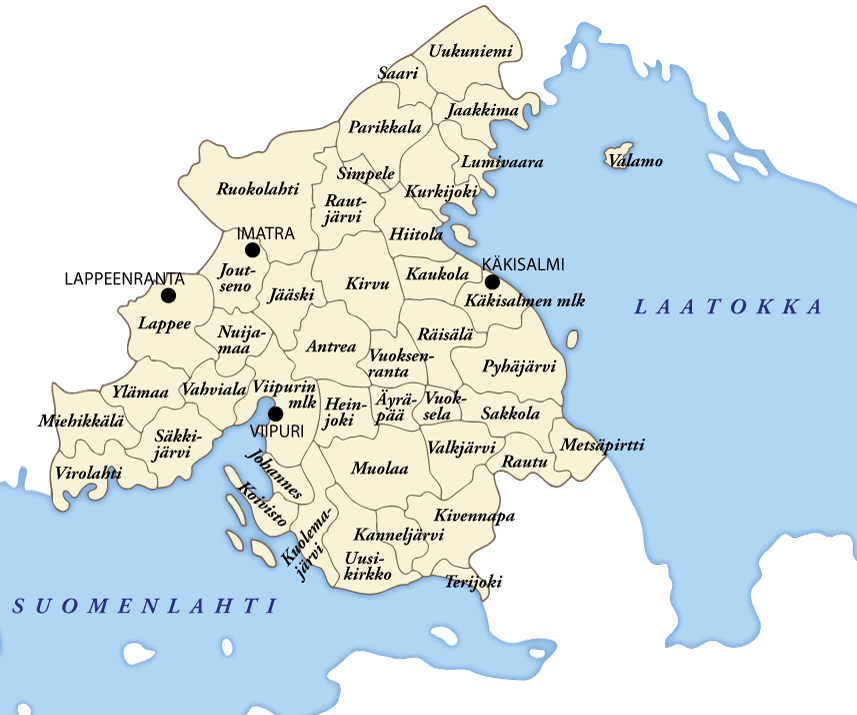
In June 1930 began my 15-month training in the Military Intelligence Corps. We ended up almost immediately at a bootcamp in Perkjärvi [Muolaa district near Viborg on the Karelian Isthmus],
and there we new recruits got sandblasted. Clouds of sand flew around us as we boys were made to run and march. Especially in the beginning when we were commanded to sing, and not a single one of us could get even a word out of our mouths, and so we ran. And when we came to a halt, we were ordered to sing once again. So in one day we learned how to do it. Clear as a bell resounded the words and melody of the song “Eskolan Kaisamuori” [Old Lady Kaisa from Eskola] out of the throats of these young recruits, and the Chaplain for the Battery ran out absolutely horrified to demand from the Lieutenant why these boys were singing such irreverent, foul songs. But the Lieutenant could care less what the Chaplain thought. The main thing was that these boys learned the marching songs.
 |
| Antero Tolvanen in the Homeguard Military Intelligence Battery unit. 1931. |
And so because of the singing it turned out that I was made the choirmaster for the Battery. Even if I have to say so myself, I already had experience from my choir days, and had a clear, strong baritone voice. So it became my lot to begin some tune, and start it at a pitch that didn’t become too tasking for male voices. And I performed very well. As I was leaving training camp, I had put together several verses for a new marching song. But nothing further ever became of that because the rhythm for my composition was so odd that no one could turn it into a functional marching song. At least not without a lot of practice beforehand. And that was that – my song never made it as a marching son. But I think I can still remember the first verse of it:
An Intelligence boy had just one dream
As
he stands awake on guard at camp
That when we finally arrive at the “Castle”
That when we finally arrive at the “Castle”
The
joys of life will await us,
Hämeenlinna,
such a dear place to us,
As
we think of you, our song rings out, ... etc.
Remember Korhonen.
Remember Korhonen.
Well, I can’t remember all of the song anymore. It will be a
wonder if I ever recall it again. After all it’s been 50 years this summer
since I composed it (1931). So the years
roll by! I just have to add that it didn’t take very long for me to write
that song. I discovered in myself talents that I didn’t even suspect I possessed. Several other songs were subsequently composed. The greatest body of
work were the poems I composed to various tunes at a member of the Postal
Course. We had quite of few of them, but most often I seemed to have been the composer
in between my work and my schooling. Mother had them in her possession once
upon a time, but I think she eventually discarded them along with other items.
In many of them I had tried to be especially witty to impress the girls.
 |
| Antero Tolvanen with buddies in the Homeguard Military Intelligence Battery unit. 1931. |
In the fall after returning from training camp I was in top
physical condition. I entered the Non-commissioned Officer training school and there the
men were humbled and made to crawl on their bellies.
Our training was nearly over when on one of the last days we were on the ground again, crawling along on our bellies in a wet field of hay, and I caught a chill. I dismissed it as a mild case, but by Monday morning I had to report to the medical hut. I had developed angina with an abscess on my neck as well as in my throat, and the medical skills at the camp were not adequate to treat me. The camp doctor, Tuhkanen, tried to lance the abscess in my throat with a surgical scalpel, but it was a useless effort and did nothing for it.
By now I was in a semiconscious state, and they had to call Aili to come, as she was my nearest relative. She sat next to my cot. It didn’t help my condition, of course, but at least it managed to raise my spirits. I lay in this state for about ten days until the throat abscess burst on its own. It eased my condition a lot.
 |
| Antero Tolvanen as a non-commissioned officer trainee. (2nd row, fifth from the left.) Military Intelligence Corps Regiment.1931. |
Our training was nearly over when on one of the last days we were on the ground again, crawling along on our bellies in a wet field of hay, and I caught a chill. I dismissed it as a mild case, but by Monday morning I had to report to the medical hut. I had developed angina with an abscess on my neck as well as in my throat, and the medical skills at the camp were not adequate to treat me. The camp doctor, Tuhkanen, tried to lance the abscess in my throat with a surgical scalpel, but it was a useless effort and did nothing for it.
 |
| Aili Linnea Vuori and Valto Antero Tolvanen. 1932. |
By now I was in a semiconscious state, and they had to call Aili to come, as she was my nearest relative. She sat next to my cot. It didn’t help my condition, of course, but at least it managed to raise my spirits. I lay in this state for about ten days until the throat abscess burst on its own. It eased my condition a lot.
I was starved because I hadn’t eaten anything during all this
time – but my throat was so swollen still that nothing went down, not even
water which came right back up again. But eventually I was able to eat and did
I ever chow down. I ate quite a few bowls of prune soup – nothing else would go
down. The abscess in my throat was gone, but as for the one on my neck I had to
go to the Tilkka
Military hospital in Helsinki to have it treated. A small surgical procedure was performed, and a tube was placed in my neck to drain the liquid from the abscess. But it would not heal. As I recall I was at the hospital for two months. The head surgeon had finally had enough and yanked the tube from my neck. He then pinched some nerve endings in my neck with his tweezers. Everything went black before my eyes and I think I even let out a scream.
Deciding then and there that I didn’t need any more of this kind of torture, I petitioned to be sent back to my unit. And my request was granted. There may even have been a few day’s leave. Then back to my unit and back in the harness. I was made the secretary to the Battery and served in that capacity until the end of my service.
 |
| Tilkka Military Hospital, Helsinki, Finland. 1930's. |
Military hospital in Helsinki to have it treated. A small surgical procedure was performed, and a tube was placed in my neck to drain the liquid from the abscess. But it would not heal. As I recall I was at the hospital for two months. The head surgeon had finally had enough and yanked the tube from my neck. He then pinched some nerve endings in my neck with his tweezers. Everything went black before my eyes and I think I even let out a scream.
Deciding then and there that I didn’t need any more of this kind of torture, I petitioned to be sent back to my unit. And my request was granted. There may even have been a few day’s leave. Then back to my unit and back in the harness. I was made the secretary to the Battery and served in that capacity until the end of my service.
 |
| Antero Tolvanen [middle row left] with his unit in the Homeguard Military Intelligence Unit. 1931. |
Another summer was spent in Perkjärvi, but I was left in peace.
This tough guy didn’t even have
to do the dish washing, as had been the case the
previous summer. I did do the dishes for my unit during one week on each shift because
I had to take care of the needs for my group. Some superiors stole the tobacco rations for
the group, and I went and complained to the Sergeant Major. It was something that shouldn’t have been
done, even though I was appealing not for myself but on behalf of my men who
insisted I lodge a complaint. So I appealed – and I will remember that lesson
for the rest of my life. It turned out to be the usual harassment which new
recruits undergo during their first months of service. This is how they produced
tough men, and obedient ones as well. On
the whole it was not a very pleasant experience. And when the Old Man addressed
an underling, he stood at attention, no matter how fine of a family he was
from.
 |
| Map of Finland's Karelian Isthmus before the start of World War Two. |
 |
| Valto Antero Tolvanen in his Home Guard uniform with sister Sirkka. Helsinki, 1931. |
I was released from active service in 1931, though I eventually signed up as a volunteer in the Helsinki Homeguard.
Translated from the original Finnish by Marja-Leena Tolvanen Rogers


